How Long Do Weed Gummies Last?
Weed gummies last about 6 to 8 hours in controlled dosing research. Effects usually begin 30 minutes to 2 hours after eating, peak between 1.5 and 3 hours, and fade gradually as the liver clears THC and its active metabolites.
Three separate clocks apply to every gummy. The high lasts hours, THC metabolites can remain detectable in urine for days or weeks, and the THC inside a stored package slowly degrades into cannabinol (CBN). Dose, tolerance, and storage conditions shift each clock.
Key Highlights
- A controlled Johns Hopkins study found edible THC effects peaked 1.5 to 3 hours after ingestion and lasted 6 to 8 hours at doses of 10, 25, and 50 mg.
- Edibles accounted for 10.7% of cannabis-related emergency visits at a Colorado academic hospital while representing only 0.32% of state cannabis sales.
- Massachusetts regulations limit an edible serving to 5 mg of THC and a multi-serving package to 100 mg, allowing a 10% testing variance.
- THC in stored cannabis plant material dropped about 16.6% after one year at room temperature, with CBN forming as it degrades.
- Urine tests detect THC metabolites far longer than the high lasts, averaging 13 days after heavy chronic use stops.
How Long Does a Weed Gummy High Last?
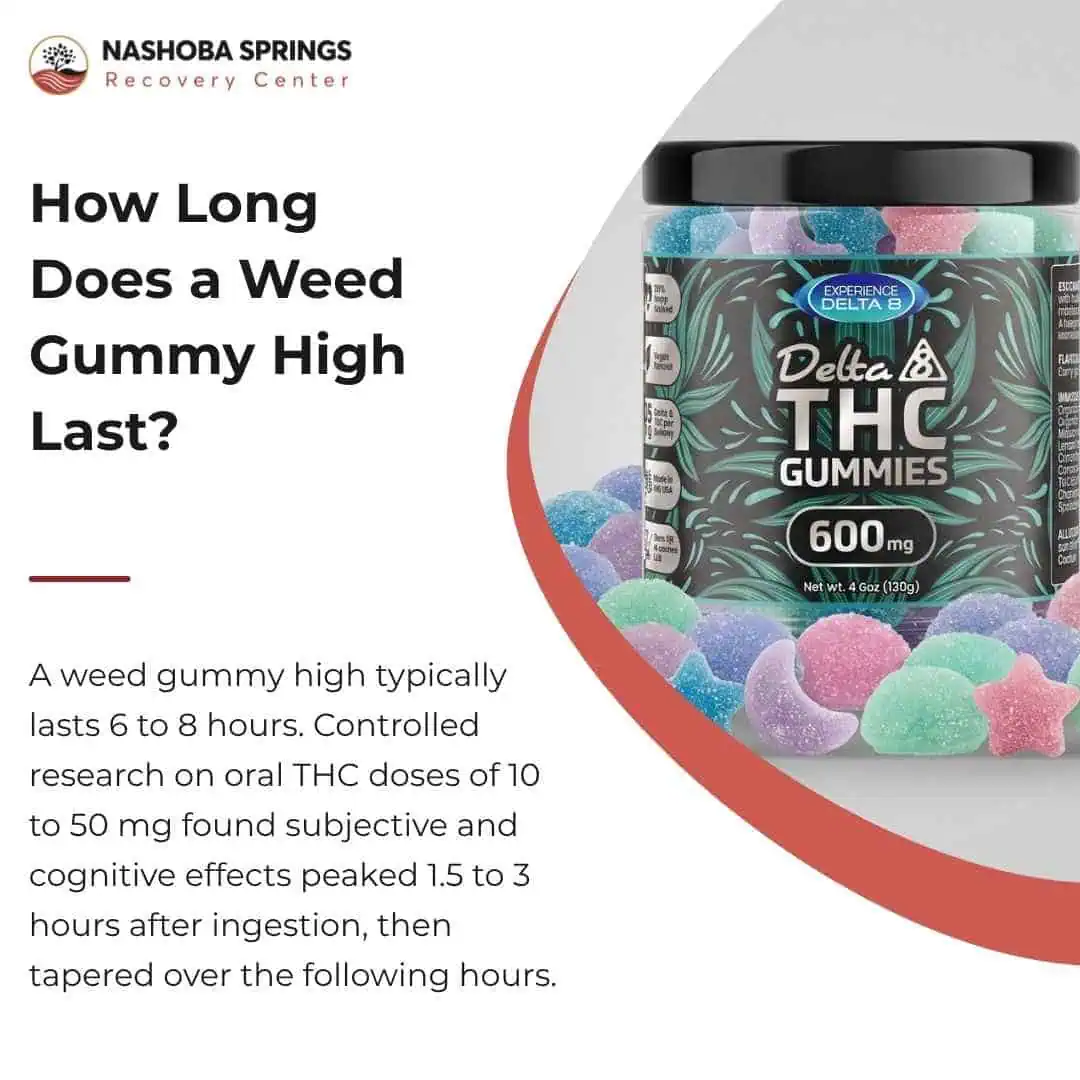
A weed gummy high typically lasts 6 to 8 hours. Controlled research on oral THC doses of 10 to 50 mg found subjective and cognitive effects peaked 1.5 to 3 hours after ingestion, then tapered over the following hours.
A weed gummy is a gelatin or pectin candy infused with delta-9-tetrahydrocannabinol (THC), the main intoxicating compound in cannabis. Swallowed THC is absorbed through the gut and processed by the liver, which produces a slower and longer experience than inhaled cannabis.
In a Johns Hopkins study published in the Journal of Analytical Toxicology, healthy adults ate cannabis brownies containing 10, 25, or 50 mg of THC. Drug effects were generally dose dependent, peaked 1.5 to 3 hours after dosing, and lasted 6 to 8 hours.
Individual response varies widely. Oral THC bioavailability ranges from only 4% to 12%, according to a pharmacology review in The Permanente Journal, so two people eating the same gummy can absorb very different amounts. Tolerance, body weight, metabolism, and product formulation also shape duration and strength.
We Believe In You – No Matter What
We provide every level of care you need for lasting recovery. From detox to aftercare, our team is ready to help you start a new chapter.
How Long Do Edibles Take to Kick In?
Edibles typically take 30 minutes to 2 hours to kick in. Slow gut absorption delays onset, and peak blood THC levels arrive about 1 to 2 hours after ingestion, compared with 5 to 10 minutes after smoking.
The delay comes from the digestive route. A CDC report in Morbidity and Mortality Weekly Report noted that ingested THC reaches mean peak plasma concentration 1 to 2 hours after ingestion, versus 5 to 10 minutes when smoked. A NIDA-funded research protocol notes that edible intoxication can be delayed up to two hours or more.
| Phase | Time After Eating | What Happens |
|---|---|---|
| Absorption | 0 to 30 minutes | THC moves through the stomach and small intestine; effects are usually absent |
| Onset | 30 minutes to 2 hours | First noticeable effects, such as relaxation, altered perception, and faster heart rate |
| Peak | 1.5 to 3 hours | Strongest subjective and cognitive effects in controlled trials |
| Decline | 3 to 8 hours | Effects gradually taper as THC and 11-hydroxy-THC are metabolized |
| Residual | 8 to 24 hours | Grogginess may linger; THC remained detectable in blood for up to 22 hours in one study |
Why Do Edibles Last Longer Than Smoking?
Edibles last longer than smoked cannabis because swallowed THC passes through the liver first. Liver enzymes convert part of it into 11-hydroxy-THC, a psychoactive metabolite, while slow gut absorption stretches THC release over several hours.
After a gummy is swallowed, THC travels from the gut to the liver before reaching general circulation. A review in The Permanente Journal explains that liver enzymes CYP2C and CYP3A convert THC into 11-hydroxy-THC (11-OH-THC), which is psychoactive, and then into 11-nor-9-carboxy-THC (THCCOOH), which is not.
Inhaled THC largely bypasses this first-pass step. In the Johns Hopkins brownie study, blood levels of 11-OH-THC rose and peaked on a timeline similar to THC itself, so both compounds contribute during the peak window. THC is also highly fat soluble, which lets tissue stores release it slowly after use.
How Does THC Dose Change How Long a Gummy Lasts?
Higher THC doses produce stronger and longer effects. Controlled trials show effects intensify from 10 mg to 25 mg and 50 mg, while Massachusetts sets a standard edible serving at 5 mg of THC to limit overconsumption risk.
Massachusetts regulation 935 CMR 500.150 limits a single edible serving to 5.5 mg of active THC and a multi-serving package to 110 mg, figures that include a 10% testing variance. In practice, a standard serving is 5 mg, and a full package holds 100 mg across 20 servings.
Dose effects were measured in a 2020 Johns Hopkins study of 17 healthy adults who had not used cannabis for at least 60 days. Participants ate brownies containing 0, 10, 25, or 50 mg of THC, and effects peaked 1.5 to 3 hours after ingestion. Two participants vomited, one at 25 mg and one at 50 mg.
Tolerance changes the curve. People who use cannabis daily typically feel less from the same dose, while first-time users can feel strong effects from 5 to 10 mg. Counting the milligrams printed on the label, rather than gummy pieces, gives the most reliable measure of dose.
Verify Your Insurance Coverage Today
We work with most major insurance providers to make treatment accessible. Check if your plan covers care at Nashoba Springs Recovery.








How Long Do Edibles Stay in Your System?
Edible THC stays in the body far longer than the high. Blood tests detected THC for up to 22 hours after single edible doses. Mayo Clinic Proceedings reports urine positives up to 1 week after a single use and up to 46 days after long-term use.
Drug tests target different compounds. Blood and oral fluid tests look for THC itself, which clears within about a day after a single edible. Urine tests look for THCCOOH, an inactive metabolite stored in and released from fat tissue, which extends detection well beyond the felt effects.
| Measure | Single or Occasional Use | Frequent or Heavy Use |
|---|---|---|
| Felt effects | 6 to 8 hours | Often shorter or milder due to tolerance |
| Blood (THC) | Up to 22 hours after 10 to 50 mg edible doses | Longer, varying with use pattern |
| Oral fluid (THC) | 1.9 to 22 hours after edible doses | Varies with use pattern |
| Urine (THCCOOH) | Typically up to 72 hours after a single exposure in nonusers (Mayo Clinic Proceedings, 2017) | Average of 13 days after heavy use, with a range of 9 to 25 days; more than 30 days in some chronic users (Mayo Clinic Proceedings, 2017) |
Do Weed Gummies Expire?
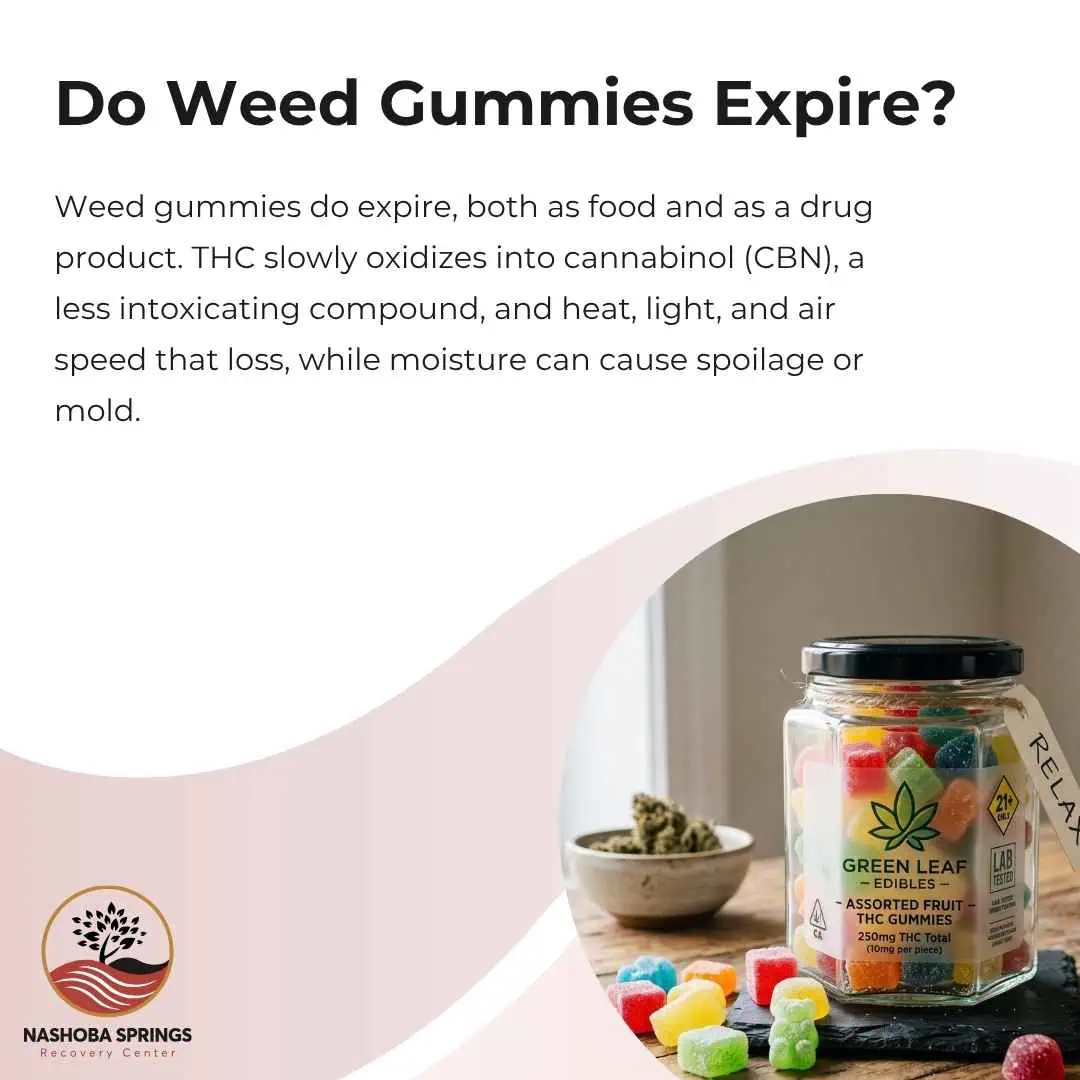
Weed gummies do expire, both as food and as a drug product. THC slowly oxidizes into cannabinol (CBN), a less intoxicating compound, and heat, light, and air speed that loss, while moisture can cause spoilage or mold.
No peer-reviewed study has tracked THC loss in commercial gummies specifically, so potency estimates come from cannabis plant material and resin. A United Nations Office on Drugs and Crime analysis found THC in marijuana stored at room temperature fell 16.6% after one year and 41.4% after four years.
Massachusetts rules under 935 CMR 500.150 require perishable edibles to carry a statement that they must be refrigerated. Stored gummies degrade into a weaker product rather than a stronger one, so an old gummy usually delivers less THC. Visible mold, off odors, or a changed texture signal food spoilage regardless of potency.
We Believe In You – No Matter What
We provide every level of care you need for lasting recovery. From detox to aftercare, our team is ready to help you start a new chapter.
What Happens When Someone Takes Too Many Edibles?
Taking too many edibles can cause intense anxiety, panic, vomiting, rapid heart rate, and psychotic symptoms. These effects usually resolve as THC wears off, but they can last many hours and send people to emergency departments.
Jacob Lewis, MLADC, a Licensed Master’s Level Alcohol and Drug Counselor at Nashoba Springs Recovery Center, describes the pattern: “Delayed onset is the trap with gummies. Someone feels nothing after an hour, takes a second piece, and then both doses peak together. Counting milligrams instead of pieces is the simplest safeguard.”
Accidental exposures are also rising among young people. A JAMA Network Open study of the regional poison center serving Massachusetts found single-substance cannabis exposure calls for people aged 0 to 19 rose from 0.4 to 1.1 per 100,000 population after medical marijuana legalization. NIDA identifies children eating cannabis edibles, such as gummies, as a growing health concern.
Treatment for Cannabis Use Disorder
Frequent edible use becomes a concern when cravings, rising tolerance, failed attempts to cut back, or missed responsibilities appear. These are core features of cannabis use disorder, a treatable condition that often co-occurs with anxiety or depression.
Nashoba Springs Recovery Center in Groton provides Marijuana Addiction Treatment built on CBT, DBT, SMART Recovery, and Dharma Recovery programming. A psychiatric medical director completes an assessment within 48 hours of admission.
The Partial Hospitalization Program runs 30 to 45 days as day treatment, and clients can step down to the Intensive Outpatient Program which fits around work, school, and family responsibilities.
Continuing care follows through outpatient rehab with weekly individual therapy at minimum. Because heavy cannabis use often overlaps with depression, anxiety, or PTSD, dual diagnosis treatment addresses both conditions within one plan. Family therapy and holistic options such as yoga, Reiki, and breath work round out programming.
Verify Your Insurance Coverage Today
We work with most major insurance providers to make treatment accessible. Check if your plan covers care at Nashoba Springs Recovery.
Frequently Asked Questions About Weed Gummies
Is a 100 mg Gummy Edible a Lot?
Yes. A 100 mg gummy equals 20 standard Massachusetts servings of 5 mg each and matches the state’s entire per-package THC limit. That amount is double the highest dose tested in controlled edible trials, where 50 mg caused hours of impairment. For occasional users, it carries a high risk of severe anxiety, vomiting, and prolonged impairment.
Is a 20 mg Gummy Edible a Lot?
For most occasional users, yes. A 20 mg gummy equals four Massachusetts standard servings. In controlled trials, 25 mg of oral THC impaired attention and cognitive performance for several hours, while 10 mg did not produce significant cognitive impairment. Frequent users with established tolerance may experience 20 mg as moderate.
Can Someone Eat Edibles That Are 2 Years Old?
A 2-year-old gummy is usually weaker, not more dangerous, if it shows no signs of spoilage. In stored cannabis plant material, about 26.8% of THC degraded after two years at room temperature. Gummies past the label date, or with mold, odor, or texture changes, should be discarded.
Is It Safe to Drive After Eating a Weed Gummy?
No. Driving during the 6 to 8 hour effect window is unsafe, because controlled research shows edible THC impairs attention and processing speed for hours at moderate doses. THC also remained measurable in blood for up to 22 hours after edible doses in the same research.
References
- Chayasirisobhon, S. (2020). Mechanisms of action and pharmacokinetics of cannabis. The Permanente Journal, 25, 1–3. NIH
- Colorado Department of Revenue. (n.d.). Safety with edibles. Responsibility Grows Here. cannabis.colorado.gov
- Massachusetts Cannabis Control Commission. (2025). Cannabis Control Commission releases industry report assessing adult- and medical-use cannabis markets.
- Massachusetts Cannabis Control Commission. (n.d.). 935 CMR 500.000: Adult use of marijuana. MASS
- Moeller, K. E., Kissack, J. C., Atayee, R. S., & Lee, K. C. (2017). Clinical interpretation of urine drug tests: What clinicians need to know about urine drug screens. Mayo Clinic Proceedings, 92(5), 774–796.
- Moeller, K. E., Lee, K. C., & Kissack, J. C. (2008). Urine drug screening: Practical guide for clinicians. Mayo Clinic Proceedings, 83(1), 66–76.
- Monte, A. A., Shelton, S. K., Mills, E., Saben, J., Hopkinson, A., Sonn, B., Devivo, M., Chang, T., Fox, J., Brevik, C., Williamson, K., & Abbott, D. (2019). Acute illness associated with cannabis use, by route of exposure: An observational study. Annals of Internal Medicine, 170(8), 531–537.
- Ross, S. A., & ElSohly, M. A. (1997). CBN and Δ9-THC concentration ratio as an indicator of the age of stored marijuana samples. Bulletin on Narcotics, 49(1–2), 139–147.
- Schlienz, N. J., Spindle, T. R., Cone, E. J., Herrmann, E. S., Bigelow, G. E., Mitchell, J. M., Flegel, R., LoDico, C., & Vandrey, R. (2020). Pharmacodynamic dose effects of oral cannabis ingestion in healthy adults who infrequently use cannabis. Drug and Alcohol Dependence, 211, 107969.
- Schuster, R. M., Potter, K., Vandrey, R., Hareli, M., Gilman, J., Schoenfeld, D., & Evins, A. E. (2020). Urinary 11-nor-9-carboxy-tetrahydrocannabinol elimination in adolescent and young adult cannabis users during one month of sustained and biochemically-verified abstinence. Journal of Psychopharmacology, 34(2), 197–210.